
California policymakers, public agencies, insurers, and technology leaders face deep uncertainty when deciding where and how to implement fire mitigation strategies. To address these complex challenges, the UCLA Sustainable LA Grand Challenge (SLAGC) hosted the second webinar in a three-part series designed to bring academic, agency, and industry experts together to address questions about how we can develop policies that help us live with future fire. A summary and video of the first webinar, Policymaking Under Uncertainty: Zone 0 and Vegetation Clearance, is available here.
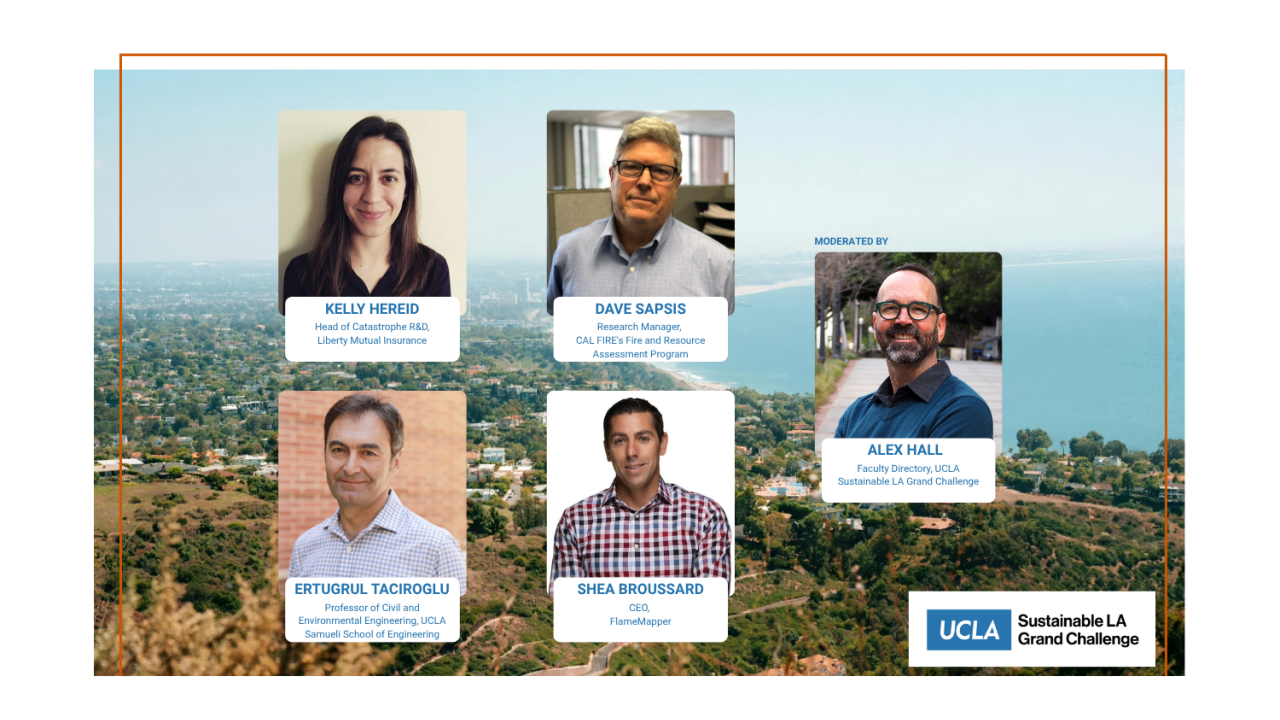
The August 6 webinar, Policymaking Under Uncertainty: Deciding Where to Implement Fire Mitigation Strategies was hosted and moderated by Alex Hall, Faculty Director of SLAGC and Director of the UCLA Institute of the Environment and Sustainability. The panel featured four distinct perspectives across insurance, state forestry, private technology, and academic engineering:
- Kelly Hereid, Head of Catastrophe R&D at Liberty Mutual Insurance
- Dave Sapsis, Research Manager for CAL FIRE's Fire and Resource Assessment Program
- Shea Broussard, CEO of Flame Mapper
- Ertugrul Taciroglu (E.T.), Professor and Chair of Civil and Environmental Engineering at UCLA
Watch the full webinar discussion below and stay tuned for the final one in the series.
Multi-Layered Defenses and Mitigation Priorities
- Kelly Hereid introduced the "Swiss cheese" model of wildfire defense, noting that because every single intervention has inherent weaknesses, communities must stack building-level hardening, community planning, and landscape treatments so the strengths of one layer fortify the weaknesses of another.
- Dave Sapsis emphasized that effective mitigation requires targeted frameworks, explaining that public policy can design interventions to reduce hazard (fire intensity), exposure (what assets lie in fire paths), or vulnerability (asset susceptibility).
- Shea Broussard highlighted that while proactive mitigation is effective, it suffers from a lack of public visibility. He showed how utilizing the right geospatial technology and methodology can effectively identify and rank spatial mitigation projects by quantifying potential structure destruction and demonstrated how the ranking of mitigation projects can effectively maximize impact and best utilize limited public funding. His presentation included a brief example of his firm FlameMapper's work in Beverly Hills.
- E.T. argued that validated computer simulations allow decision-makers to stress-test mitigation strategies in silico, converting fuel treatments, home hardening, or corridor improvements into concrete dollar savings and risk reductions parcel by parcel.
“[W]ith wildfire, every layer of defense that we have has holes in it... To be able to think about how to reduce that risk, we need to layer on multiple layers of defense so that the weaknesses in one layer can be fortified by the strengths in another area.” — Kelly Hereid
Defining Hazard, Risk, and Predictive Modeling Approaches
- Kelly Hereid detailed how insurers rely on catastrophe models to simulate 10,000 to 100,000 years of hypothetical, physically plausible fire events to evaluate rare, tail-risk catastrophes across entire portfolios.
- Dave Sapsis provided foundational definitions for policy, separating physical "hazard", the agent of fire likelihood and power, from "risk", the resulting monetary and non-market damages to structures, lives, and ecosystems.
- Shea Broussard focused on operational prediction, explaining how FlameMapper's EmberCast leverages large language models to aggregate environmental data and streamline predictive inputs down to two variables, delivering real-time fire spread modeling during active suppression.
- E.T. presented a physics-based workflow to bridge regulatory maps and insurance models, combining future climate projections, satellite fuel mapping at 30-meter resolution, and probabilistic fire spread simulations.
“Hazard is the physical condition that may lead to adverse impacts or damages. It is the agent that causes change. Risk is an estimate of effects or damage arising from hazard. It is an estimate of what those impacts and changes are.” — Dave Sapsis
Urban Fuels, Structure Spread, and Science Gaps
- Kelly Hereid noted that structure separation distance dominates risk in dense neighborhoods, explaining that when homes are built closer than 10 feet apart, an adjacent burning home will destroy neighboring properties regardless of parcel hardening.
- Dave Sapsis identified urban conflagrations as a primary science gap, explaining that predicting how embers ignite discontinuous structural fuels requires merging wildland forestry with structural fire engineering.
- Shea Broussard highlighted a critical modeling finding: internal structure contents such as plastics and synthetic furnishings often dictate urban fire spread through communities more than exterior building materials.
- E.T. observed that urban fuels are a shared blind spot in regulatory maps, citing post-fire field data from the January 2025 Eaton Fire in Altadena to demonstrate how structure-to-structure propagation drives catastrophic losses.
“One of the biggest puzzle pieces [...] is what the urban fuels are and how the wildfires or fires are spreading from structure to structure. What was a wildland problem is becoming increasingly a wildland urban interface problem that hasn’t been studied with the requisite detail just yet.” — Ertugrul Taciroglu
Cross-Sector Collaboration, Benchmarking, and Policy Tradeoffs
- Kelly Hereid pointed out that California's development restrictions in lower-risk urban centers push new housing into high fire-hazard areas, putting the state's housing crisis on a direct collision course with its wildfire crisis.
- Dave Sapsis advocated for open model intercomparisons and rigorous benchmarking against real-world fire occurrences such as San Jose State's "Firebench" initiative to prevent model shopping and ensure predictive integrity.
- Shea Broussard emphasized the need to incentivize collaboration among private tech companies, arguing that a framework needs to be identified and established to share data and transparent science while also preserving private company IP. It is necessary to work towards building community trust in modeling tools while more rapidly advancing the sciences through collaboration.
- E.T. stressed that wildfire risk is inherently a community-scale issue rather than an individual parcel choice. He also urged policymakers to define and adopt performance-based criteria (such as prioritizing life safety), which are commonly used for other hazards, including earthquakes and hurricanes.
“[W]e don’t want to be pushing the wrong science. We need to build trust in the community, and we need to do that together.” — Shea Broussard
Looking Ahead
Despite efforts at prevention and mitigation, losses and destruction from fire are increasing as fire becomes more frequent under severe conditions, such as high winds and drought. As conditions for extreme fire become more widespread due to the pressures of climate change, it will take time to achieve large-scale resilience.
Alex Hall concluded the webinar by emphasizing that despite modeling uncertainties and scientific gaps, insurers, state agencies, and local governments must make real-world policy decisions today.
Stay tuned for the third and final webinar in the Polymaking Under Uncertainty series, which will continue bringing experts together to explore science-backed solutions for living with future fire.