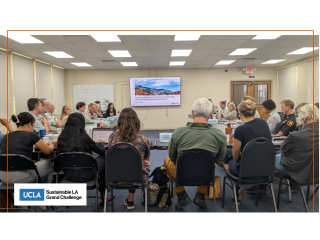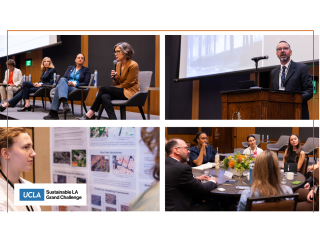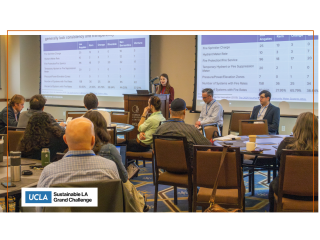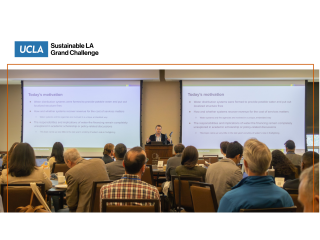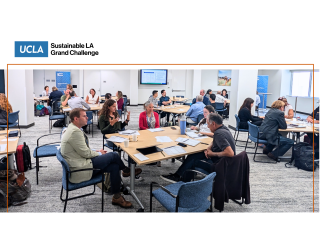
On January 23, 2026, the UCLA and UC ANR Urban Water Supply + Fire working group—organized by the Sustainable LA Grand Challenge, Luskin Center for Innovation, and the California Institute for Water Resources—convened 47 experts for the second of four workshops digging into the realities of planning water systems for a future with changing fire risks. Read more.
Homepage Highlight
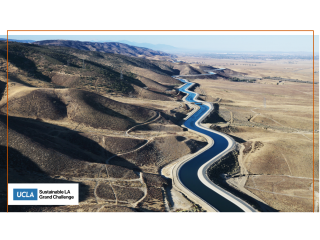
LADWP manages the water supply for about 4 million residents. LADWP has the critical task of ensuring that the water supply can support a growing population in the face of a changing climate. Read about how UCLA helps.
As urban wildfires become more frequent and severe, what role can water systems realistically play in protecting lives, supporting emergency response, and guiding resilient rebuilding? A new report from the Luskin Center for Innovation, Water Systems’ Wildfire Fighting Capacities and Expectations, begins to answer this question. The report synthesizes the findings and discussion from a convening of more than 50 experts convened through the UCLA-UCANR Water Supply + Wildfire Research and Policy Coordination Network to tackle these critical questions.
Watch the the first in a series of webinar discussions on defensible space that SLAGC is organizing. During Policymaking Under Uncertainty: Zone 0 and Vegetation Clearance, experts discussed what is and—crucially—what isn't known about the role vegetation plays in fire spread. Read more.
SLAGC brought together dozens of UCLA experts from across disciplines to discuss their research related to the 2025 LA fires, their impacts, and recovery efforts over the course of three lunch dialogue events in October. Read more and watch videos of the experts discussing their work.
A report released today by UCLA—in partnership with LADWP—identifies four areas critical to strengthening water and power infrastructure to reduce risks and improve reliability as climate-related disasters intensify. It details important findings from an intensive June 9 workshop—commissioned by LADWP and developed, organized and hosted by UCLA Luskin Center for Innovation with programmatic and logistical support from the Sustainable LA Grand Challenge (SLAGC)—that brought together key decision-makers to talk frankly and collaboratively to advance broader industry knowledge and capacity.
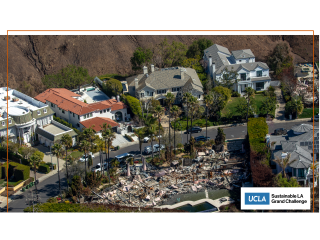
The January 2025 fires in Los Angeles made clear an issue that has been brewing for years: as wildfires become more urban in nature, what is the role of urban water systems in their prevention, response and recovery? How should water systems prepare for 21st century wildfire events? What policy changes and infrastructure investments are needed to increase resilience? Read about what the experts had to say about these questions at the first of four workshops hosted through a water supply + wildfire research and policy coordination network.
No roadmap for recovery from the devastating January 2025 LA fires would be complete without meaningful engagement and inclusion of those who lived through the disaster and who are now navigating its aftermath. Read about how UCLA facilitated a robust community engagement effort that ensured the voices, concerns, and perspectives of fire survivors could inform the Blue Ribbon Commission’s recommendations.