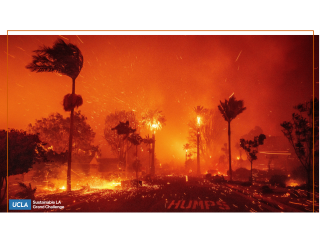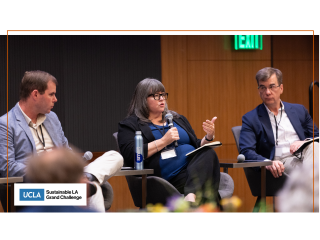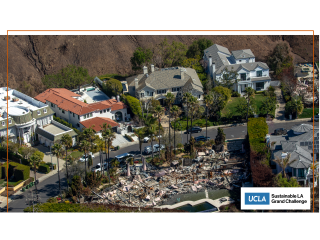
The Sustainable LA Grand Challenge will host a day-long symposium Urban Firestorms: Risk and Resilience on Thursday, May 7, 2026. Join us as we work together to build the roadmap for a more resilient American West in the face of dynamic and evolving disasters with a focus on how to pioneer new ways for universities to collaborate across disciplines, and with civic institutions and communities to create more impactful and responsive research.
Recent News Articles
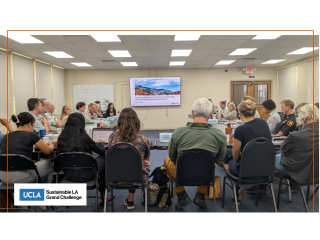
On January 23, 2026, the UCLA and UC ANR Urban Water Supply + Fire working group—organized by the Sustainable LA Grand Challenge, Luskin Center for Innovation, and the California Institute for Water Resources—convened 47 experts for the second of four workshops digging into the realities of planning water systems for a future with changing fire risks. Read more.
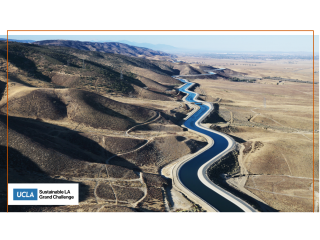
LADWP manages the water supply for about 4 million residents. LADWP has the critical task of ensuring that the water supply can support a growing population in the face of a changing climate. Read about how UCLA helps.
As urban wildfires become more frequent and severe, what role can water systems realistically play in protecting lives, supporting emergency response, and guiding resilient rebuilding? A new report from the Luskin Center for Innovation, Water Systems’ Wildfire Fighting Capacities and Expectations, begins to answer this question. The report synthesizes the findings and discussion from a convening of more than 50 experts convened through the UCLA-UCANR Water Supply + Wildfire Research and Policy Coordination Network to tackle these critical questions.
Watch the the first in a series of webinar discussions on defensible space that SLAGC is organizing. During Policymaking Under Uncertainty: Zone 0 and Vegetation Clearance, experts discussed what is and—crucially—what isn't known about the role vegetation plays in fire spread. Read more.
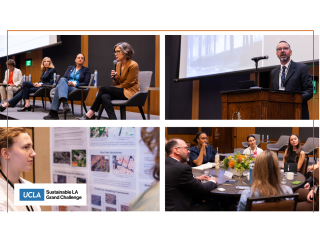
SLAGC brought together dozens of UCLA experts from across disciplines to discuss their research related to the 2025 LA fires, their impacts, and recovery efforts over the course of three lunch dialogue events in October. Read more and watch videos of the experts discussing their work.
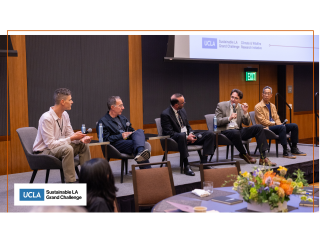
SLAGC concluded the series of lunch dialogues on October 23 with another group of six researchers covering a range of topics, including an overview of UCLA’s mental and physical health research related to the fires to soil health, smoke and air quality impacts on people, and effects of the fires on marine life. Read more.
Following up on the October 2 event, SLAGC curated another, equally diverse range of experts to present at the October 10 lunch. Some of the presentations built on the topics of the previous event—like the role urban trees played in the dynamics of fire spread in January 2025—while others introduced new topics, like the impact of the fires on education and service access of children in foster care. Read more.
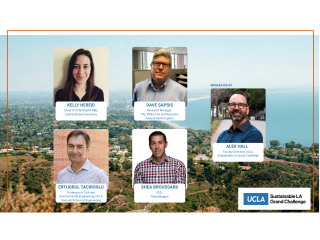
A report released today by UCLA—in partnership with LADWP—identifies four areas critical to strengthening water and power infrastructure to reduce risks and improve reliability as climate-related disasters intensify. It details important findings from an intensive June 9 workshop—commissioned by LADWP and developed, organized and hosted by UCLA Luskin Center for Innovation with programmatic and logistical support from the Sustainable LA Grand Challenge (SLAGC)—that brought together key decision-makers to talk frankly and collaboratively to advance broader industry knowledge and capacity.
At the first of the three lunch dialogue events, attendees heard from experts working in the areas of public policy, water infrastructure, urban planning, public health communications and community outreach, and the role vegetation plays in the vulnerability of the built environment. Read more.