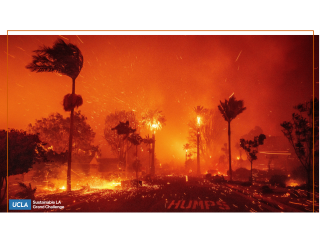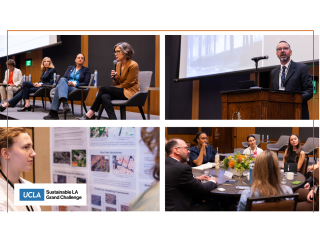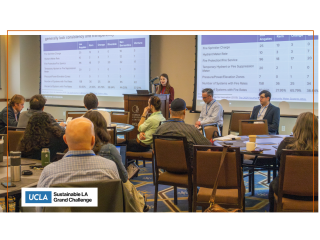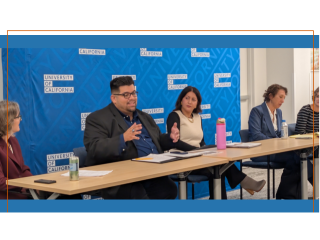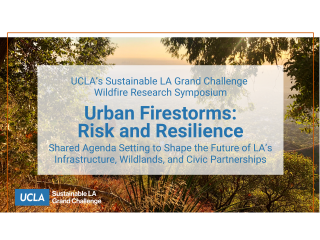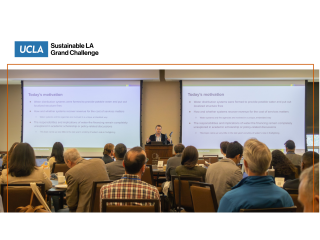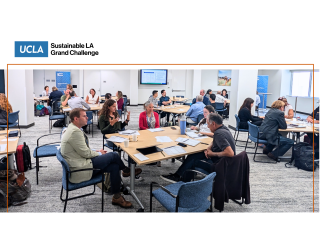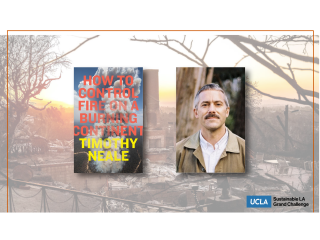
The Sustainable LA Grand Challenge will host a day-long symposium Urban Firestorms: Risk and Resilience on Thursday, May 7, 2026. Join us as we work together to build the roadmap for a more resilient American West in the face of dynamic and evolving disasters with a focus on how to pioneer new ways for universities to collaborate across disciplines, and with civic institutions and communities to create more impactful and responsive research.
Recent Slagc News News Articles
On January 23, 2026, the UCLA and UC ANR Urban Water Supply + Fire working group—organized by the Sustainable LA Grand Challenge, Luskin Center for Innovation, and the California Institute for Water Resources—convened 47 experts for the second of four workshops digging into the realities of planning water systems for a future with changing fire risks. Read more.
As urban wildfires become more frequent and severe, what role can water systems realistically play in protecting lives, supporting emergency response, and guiding resilient rebuilding? A new report from the Luskin Center for Innovation, Water Systems’ Wildfire Fighting Capacities and Expectations, begins to answer this question. The report synthesizes the findings and discussion from a convening of more than 50 experts convened through the UCLA-UCANR Water Supply + Wildfire Research and Policy Coordination Network to tackle these critical questions.
A report released today by UCLA—in partnership with LADWP—identifies four areas critical to strengthening water and power infrastructure to reduce risks and improve reliability as climate-related disasters intensify. It details important findings from an intensive June 9 workshop—commissioned by LADWP and developed, organized and hosted by UCLA Luskin Center for Innovation with programmatic and logistical support from the Sustainable LA Grand Challenge (SLAGC)—that brought together key decision-makers to talk frankly and collaboratively to advance broader industry knowledge and capacity.
New data comes from UCLA's 2025 Southern California Community Water Systems Atlas shows that in Los Angeles County, average household water bills climbed nearly 60% from 2015 to 2025, faster than inflation, putting significant strain on the region's lower-income households. Read more.
Global warming has advanced wildfire season from one to almost seven weeks earlier, a new UCLA study shows.
In the wake of the January 2025 LA fires, LADWP commissioned UCLA—through its long-standing partnership with the university, stewarded by SLAGC—to bring together leading subject matter experts, high-level industry decision-makers at the cutting edge of innovation in water and energy infrastructure, and leadership from multiple regional utilities to tackle the challenges facing the country's largest municipal utility in the face of growing climate risks. Read more.
For households, going electric can reduce greenhouse gas emissions and provide healthier indoor air quality—but what happens to their energy bills? This is a critical question facing the LA Department of Water and Power (LADWP) as the utility aims to transition to renewable energy equitably. A new UCLA tool, built through the university's partnership with LADWP, illustrates potential savings across household types and upgrade scenarios.
More than 40 scholars contributed their expertise to the independent commission, which issued its final recommendations today.
The effort was led by the Luskin Center of Innovation, in partnership with the Emmett Institute on Climate Change and the Environment and with support from the Sustainable LA Grand Challenge. Read more.
UCLA’s Climate & Wildfire Research Initiative (CWRI) Launches New Research and Policy Working Group on Urban Water Supply-Wildfire Dynamics, led by UCLA’s Luskin Center for Innovation (LCI) in partnership with UC Agriculture and Natural Resources’ (UCANR) California Institute for Water Resources