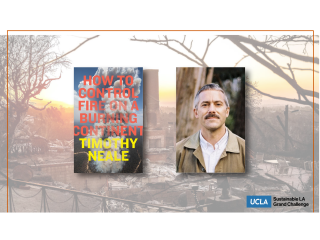
Join us on October 13 for a conversation with Dr. Timothy Neale, author of How to Control Fire on a Burning Continent. Drawing on conversations with fire professionals and Indigenous land stewards, Dr. Neal links today's fire crises to ongoing colonization and argues for moving beyond the logic of control toward learning to live with a flammable world. Read more and RSVP.
Homepage Highlight
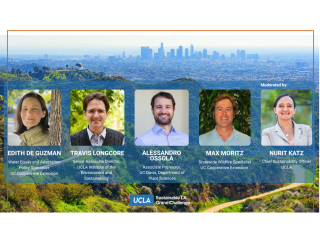
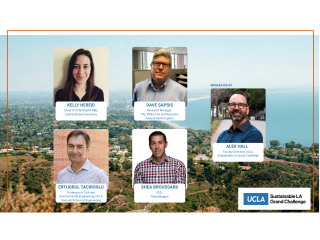
California policymakers, public agencies, insurers, and technology leaders face deep uncertainty when deciding where and how to implement fire mitigation strategies. To address these complex challenges, the UCLA Sustainable LA Grand Challenge (SLAGC) hosted the second webinar in a three-part series designed to bring academic, agency, and industry experts together to address questions about how we can develop policies that help us live with future fire. Read more.
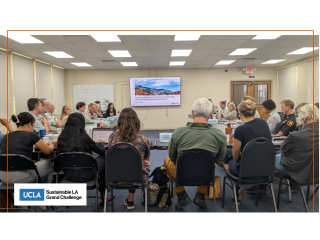
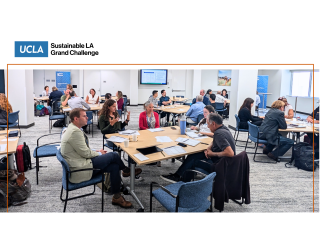
On June 12, 2026, UCLA’s Sustainable LA Grand Challenge convened 30 ecologists, community leaders, and representatives from state and local fire and land management agencies, conservation organizations, and the elected offices for a workshop titled Protecting Habitat, Preventing Destructive Fire: Creating More Effective Wildland Management Policies to identify areas of consensus regarding wildfire mitigation, firefighting practices, and ecosystem conservation, while also clarifying areas of disagreement and uncertainty. Read more.
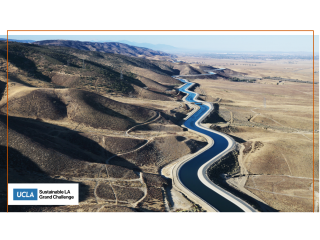
The Los Angeles Department of Water and Power (LADWP) manages one of the most critical networks of infrastructure in Southern California, delivering water and electricity to more than four million residents. Read more about how, through a long-standing partnership between UCLA and LADWP, researchers across the university are helping the community improve the resilience of its critical infrastructure so that Angelenos can continue to have access to water and power, even in an emergency.
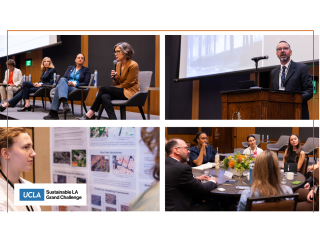
On May 7, 2026 SLAGC convened about 130 civic and community leaders, researchers, and philanthropists for a wildfire research symposium, Urban Fires: Risk and Resilience. The aim was to build the roadmap for a more resilient American West in the face of dynamic and evolving disasters with a focus on how to pioneer new ways for universities to collaborate across disciplines, and with civic institutions and communities to create more impactful and responsive research.
Read the report summarizing the January 23, 2026 UCLA and UC ANR Urban Water Supply + Fire working group convening, organized by UCLA Luskin Center for Innovation, the Sustainable LA Grand Challenge, and UC ANR. More than 50 experts gathered to examine a critical and underexplored issue: how to finance water systems as fire risks change and intensify. Read more for key insights.
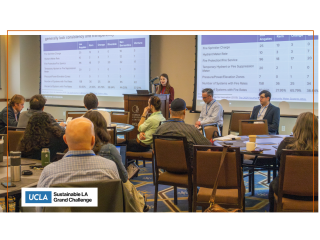
On January 23, 2026, the UCLA and UC ANR Urban Water Supply + Fire working group—organized by the Sustainable LA Grand Challenge, Luskin Center for Innovation, and the California Institute for Water Resources—convened 47 experts for the second of four workshops digging into the realities of planning water systems for a future with changing fire risks. Read more.
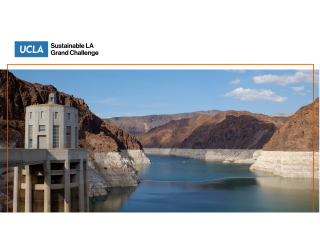
LADWP manages the water supply for about 4 million residents. LADWP has the critical task of ensuring that the water supply can support a growing population in the face of a changing climate. Read about how UCLA helps.
As urban wildfires become more frequent and severe, what role can water systems realistically play in protecting lives, supporting emergency response, and guiding resilient rebuilding? A new report from the Luskin Center for Innovation, Water Systems’ Wildfire Fighting Capacities and Expectations, begins to answer this question. The report synthesizes the findings and discussion from a convening of more than 50 experts convened through the UCLA-UCANR Water Supply + Wildfire Research and Policy Coordination Network to tackle these critical questions.
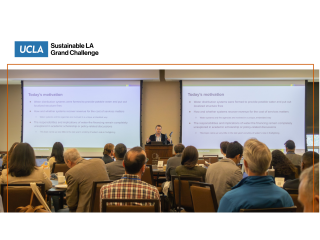
Watch the the first in a series of webinar discussions on defensible space that SLAGC is organizing. During Policymaking Under Uncertainty: Zone 0 and Vegetation Clearance, experts discussed what is and—crucially—what isn't known about the role vegetation plays in fire spread. Read more.