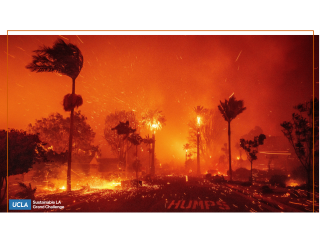
Sustainable LA Grand Challenge Faculty Director Alex Hall discusses his vision for a Santa Ana event ranking system, similar to how hurricanes are ranked, and how this can help with disaster preparedness.

Sustainable LA Grand Challenge Faculty Director Alex Hall discusses his vision for a Santa Ana event ranking system, similar to how hurricanes are ranked, and how this can help with disaster preparedness.
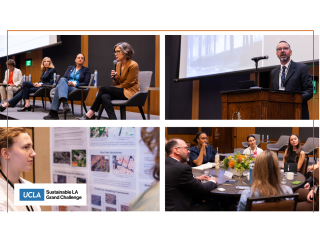
On May 7, 2026 SLAGC convened about 130 civic and community leaders, researchers, and philanthropists for a wildfire research symposium, Urban Fires: Risk and Resilience. The aim was to build the roadmap for a more resilient American West in the face of dynamic and evolving disasters with a focus on how to pioneer new ways for universities to collaborate across disciplines, and with civic institutions and communities to create more impactful and responsive research.
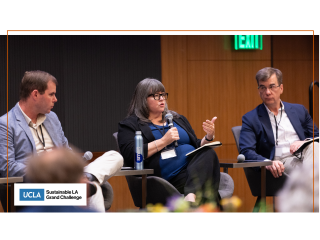
On May 7, 2026 UCLA's Sustainable LA Grand Challenge brought together about 150 civic and community leaders, researchers, and philanthropists for a day-long symposium, Urban Fires: Risk and Resilience. Read a brief synopsis and watch a video of Panel 2 | Why Can't We Stop Fires Once They Start?: The Role of Water and Infrastructure in Fighting Wildfires from that day.
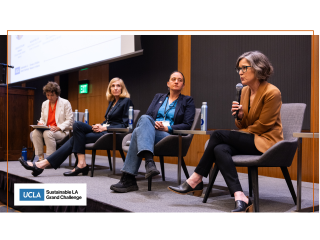
On May 7, 2026 UCLA's Sustainable LA Grand Challenge brought together about 150 civic and community leaders, researchers, and philanthropists for a day-long wildfire research symposium, Urban Fires: Risk and Resilience. Read a brief synopsis and watch a video of Panel 1 | Research Meets Reality: Mobilizing Universities for Fire Resilience from that day.
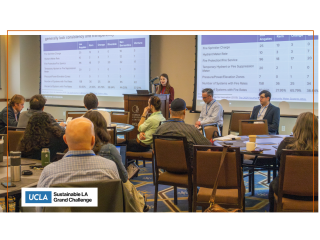
Read the report summarizing the January 23, 2026 UCLA and UC ANR Urban Water Supply + Fire working group convening, organized by UCLA Luskin Center for Innovation, the Sustainable LA Grand Challenge, and UC ANR. More than 50 experts gathered to examine a critical and underexplored issue: how to finance water systems as fire risks change and intensify. Read more for key insights.
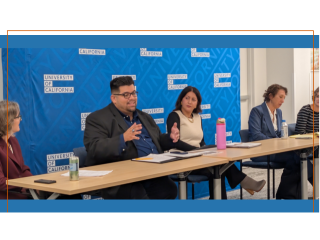
At a panel organized by the UCLA Luskin Center for Innovation, in partnership with the Emmett Institute on Climate Change & the Environment and the Sustainable LA Grand Challenge, for California state legislative staff at the UC Student and Policy Center in Sacramento on March 5, 2026, experts tackled lessons from recent flooding in Merced County and fires in LA County.
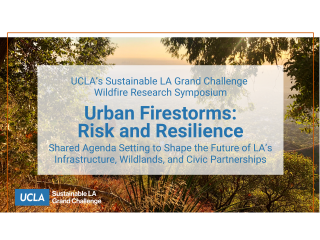
The Sustainable LA Grand Challenge will host a day-long symposium Urban Firestorms: Risk and Resilience on Thursday, May 7, 2026. Join us as we work together to build the roadmap for a more resilient American West in the face of dynamic and evolving disasters with a focus on how to pioneer new ways for universities to collaborate across disciplines, and with civic institutions and communities to create more impactful and responsive research.
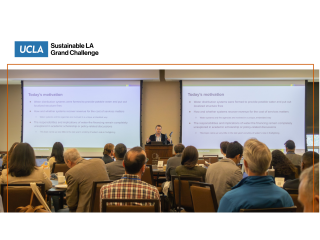
On January 23, 2026, the UCLA and UC ANR Urban Water Supply + Fire working group—organized by the Sustainable LA Grand Challenge, Luskin Center for Innovation, and the California Institute for Water Resources—convened 47 experts for the second of four workshops digging into the realities of planning water systems for a future with changing fire risks. Read more.
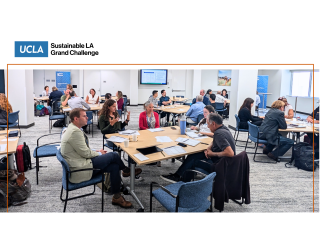
As urban wildfires become more frequent and severe, what role can water systems realistically play in protecting lives, supporting emergency response, and guiding resilient rebuilding? A new report from the Luskin Center for Innovation, Water Systems’ Wildfire Fighting Capacities and Expectations, begins to answer this question. The report synthesizes the findings and discussion from a convening of more than 50 experts convened through the UCLA-UCANR Water Supply + Wildfire Research and Policy Coordination Network to tackle these critical questions.
A report released today by UCLA—in partnership with LADWP—identifies four areas critical to strengthening water and power infrastructure to reduce risks and improve reliability as climate-related disasters intensify. It details important findings from an intensive June 9 workshop—commissioned by LADWP and developed, organized and hosted by UCLA Luskin Center for Innovation with programmatic and logistical support from the Sustainable LA Grand Challenge (SLAGC)—that brought together key decision-makers to talk frankly and collaboratively to advance broader industry knowledge and capacity.